Vincent Ward
Palimpsest | Landscapes
02 - 25 July 2026
Vincent Ward on Primal Screen with Flick Ford at 3RRR
Art Collector Magazine | Vincent Ward
Kelvin Confidential
Kelvin Club, Tuesday 07 July 2026 |
Cinema Nova Screenings
Vincent Ward. Born 1956 in New Zealand. Lives and works in Auckland, Aotearoa. Vincent Ward is a New Zealand artist, filmmaker, screenwriter, and producer whose career spans more than four decades across cinema and contemporary visual art. Internationally recognised for his visionary storytelling and distinctive visual language, Ward is regarded as one of New Zealand’s most significant and original creative voices.
Ward’s breakthrough feature, Vigil (1984), became the first New Zealand film selected In Competition for the Palme d’Or at the Cannes Film Festival, placing him within the festival’s highest competitive tier. He followed this with The Navigator: A Medieval Odyssey (1988), which also screened In Competition at Cannes to widespread international acclaim, winning numerous awards including the Australian Film Institute Awards for Best Film and Best Director. His subsequent feature, Map of the Human Heart (1992), premiered at Cannes in the Official Selection (Special Screenings), where it had its world premiere, further cementing his reputation as a filmmaker of exceptional visual and emotional ambition.
Throughout the 1990s, Ward worked extensively in Hollywood as a director, screenwriter, and producer. He received story credit for Alien 3 and developed the underlying material that later became The Last Samurai, selecting its director and serving as Executive Producer on the project. His film What Dreams May Come (1998), starring Robin Williams, Annabella Sciorra, Max von Sydow, and Cuba Gooding Jr., achieved international commercial success and won the Academy Award for Best Visual Effects, while also receiving an Academy Award nomination for Best Art Direction, noted for its pioneering “motion painting” visual approach.
As a writer, director, and producer, Ward’s films have been celebrated at major international festivals and have received more than thirty national and international awards. His later works include River Queen (2005), which won the Golden Goblet for Best Film at the Shanghai International Film Festival, and Rain of the Children (2008), which received the Grand Prix at the Era New Horizons International Film Festival in Poland. In recognition of his contribution to cinema, Ward was appointed an Officer of the New Zealand Order of Merit in 2007.
Alongside his film practice, Ward has developed a substantial body of visual art encompassing painting, photography, printmaking, and immersive installation. His work has been exhibited internationally, including a major solo presentation that occupied the interior of a cathedral at the Shanghai Biennale. Across both film and visual art, his practice continues to explore memory, landscape, identity, and the relationship between personal and collective histories.
Palimpsest | Landscapes
Palimpsest is a reinvention. The scarcity of parchment, a writing surface made from animal skin, led to its reuse during the Middle Ages through the careful scraping away of layers of ink to make way for new text. The re-used document was a palimpsest – a text with the ghost of its previous use faintly visible behind the new script. Vincent Ward’s Palimpsest/ Landscapes takes this notion of reinvention and applies it to the body, environment, language and art.
Palimpsest/Landscapes grew from my interest in painting, film, landscapes and personal histories . I apply ink, paint and pigments directly to the skin like a canvas, then breathe on it the elements, of wind, dust, rain and fog. It could be painting with light, or filming with paint, either way it’s on a new landscape; our bodies. Ephemeral as the elemental world we live in, and as harsh and varied as the hill country I experienced as a child.
Layered histories
I grew up in the Wairarapa. My father Pat, having farmed in the province for three generations, knew all the stories from his father and grandfather. They were almost always stories about the dead, or an exodus of one form or another.
Evoking a powerful sense of place that spoke in voices of those who had gone before.
When my father drained ‘the swamp,’ he found a perfect, large, Maori adze. He rolled the miracle of it around in his war-damaged hands, and assumed that the warrior and kumara planter who had abandoned it must have had large rough hands like himself. Why would he have abandoned something so precious? It was a remnant of stories retold by local kaumatua of their hapu fleeing from invading warriors.
There were other wars and other soldiers that came in waves and left. At nearby Tauherenikau there was a training camp for young men preparing to depart for World War I, many of whom would never return to this place. A place where my father would later plant trees from every nation that had participated in the war and erect a stone plinth. A generation later, Japanese prisoners of war were interned there during World War II. One Christmas, in an attempted escape from the prisoner of war camp, 48 were mown down by machine gun. My Father invited one of the surviving Japanese officers to donate a tree. Alongside the tree, he sent a plinth with a Shinto poem ‘Behold the summer grass all that belongs of the dreams of warriors.’ When you drive past the site on a hot Wairarapa day you can almost hear their whispers in the burnished fields.
In the work I reimagine the human body as deserts, mountains, caverns and river beds with breath and water both giving them life. Through filmic isolation these primordial bodies, I strive to create a new landscape where we see the forces that shape humans and the land as if they are one.
The body remembers.
My father had had three quarters of his body burnt during World War II. Years of skin grafts followed.
My mother, a Jewish refugee, had fled Germany. She was much younger than my father. They met on the edge of the Sahara during the war. To Pat it must have been as if she had risen out of the desert sand - the place where he had been burnt - her perfect form, reflecting in miniature the desert contours, its smoothness magnified and contrasted as he looked down at his own abraded body.
He was drawn to the youth and spirit of the woman and took her back to NZ where they started to farm on a ragged unbroken piece of hill country with crumbling cliffs where trees and clay would wash down into the river. Pat saw the land like his own body - broken and needing repair, and what he wanted from it was an echo of the beauty he found in the perfect form of his wife.
In Palimpsest / Landscapes ink consumes water and marks the body, just as we scar and layer the land with human history and memory.
The seemingly endless flesh grafts to my Dad’s body, from one part to another, contrasted with the perfectly straight fence-lines that he dug and wired on apparently impossible hill and cliff-edge terrain. The lines created, for a 6me, order and form - a boundary, delineating a sanctuary for my mother and for us, against the entropy they had both experienced during the war.
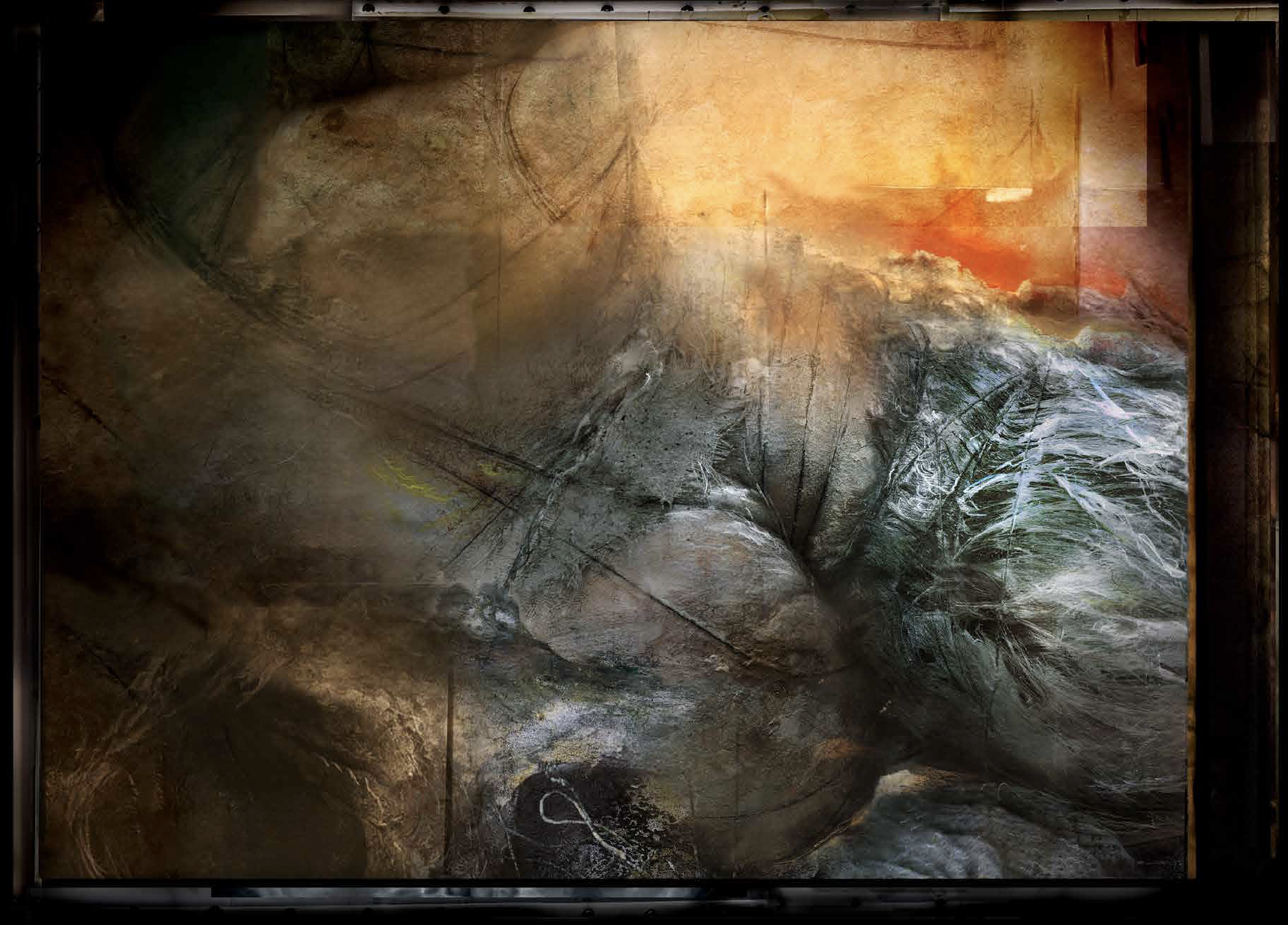
Vincent Ward | The Burnished Reef (Fire Head I) 2016 - 2026 | Pigment print on Hahnemühle fine art paper on Dibond, ed 5 + 2 AP | 1200 x 810 mm
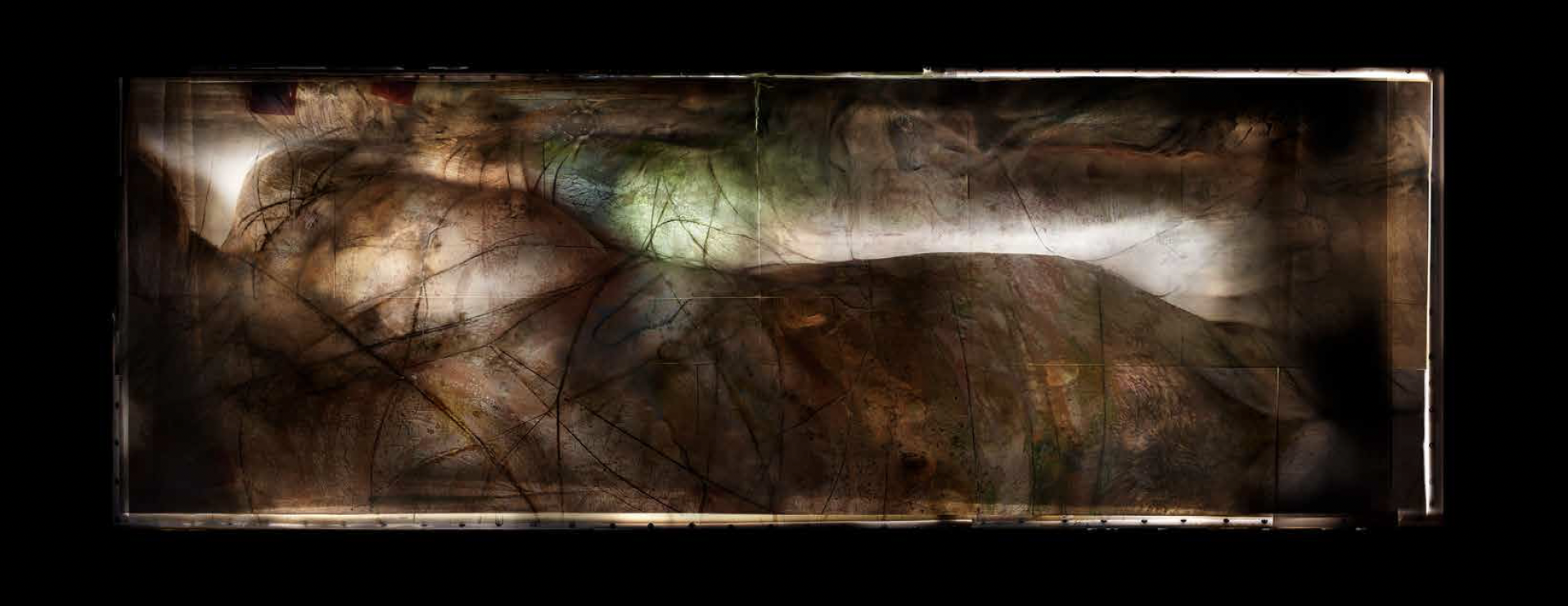
Vincent Ward | Under The Glow Of A Rising Moon, 2016 - 2026 | Pigment print on Hahnemühle fine art paper on Dibond, ed 5 + 2 AP
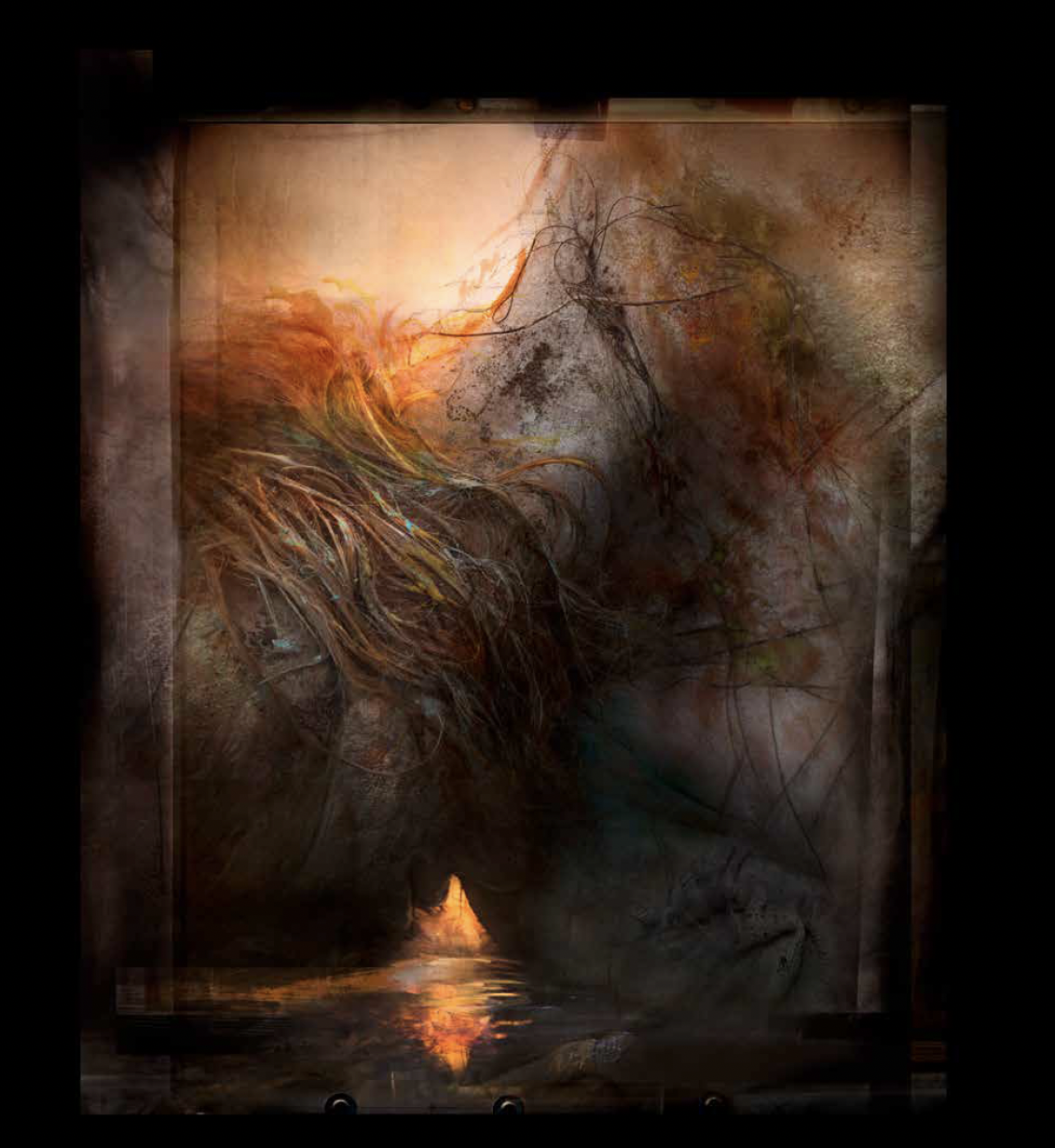
Vincent Ward | Land Form At Sun’s Rise (Fire Head II) 2016 - 2026 Pigment print on Hahnemühle fine art paper on Dibond, ed 5 + 2 AP 1090 x 915 mm

Vincent Ward | Cowled - Wing - Henge, 2016 - 2026 Pigment print on Hahnemühle fine art paper on Dibond, ed 5 + 2 AP 1060 x 710 mm
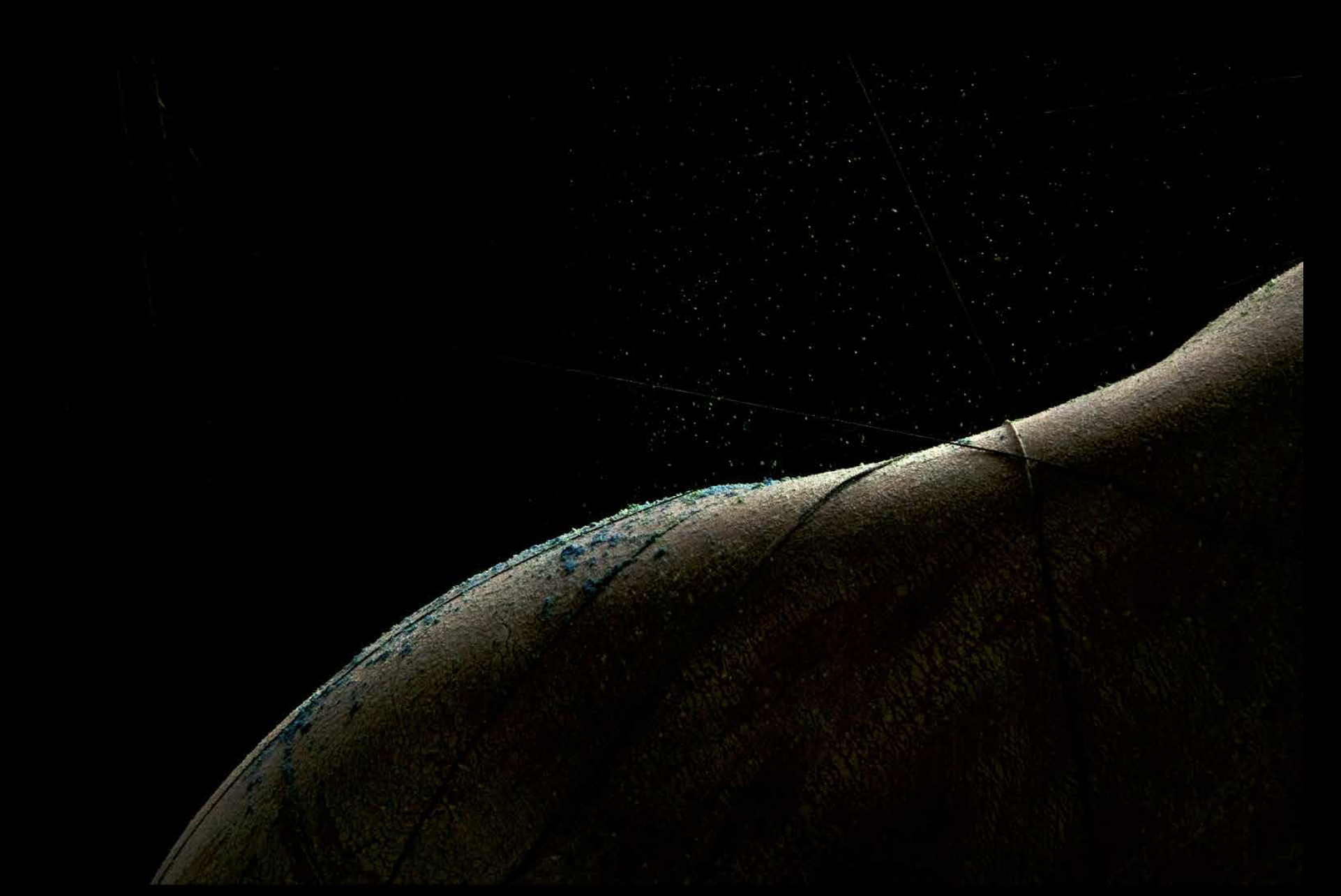
Vincent Ward | Celestial Fuselage, 2026 -2026 Pigment print on Hahnemühle fine art paper on Dibond, ed 5 + 2 AP1060 x 710 mm
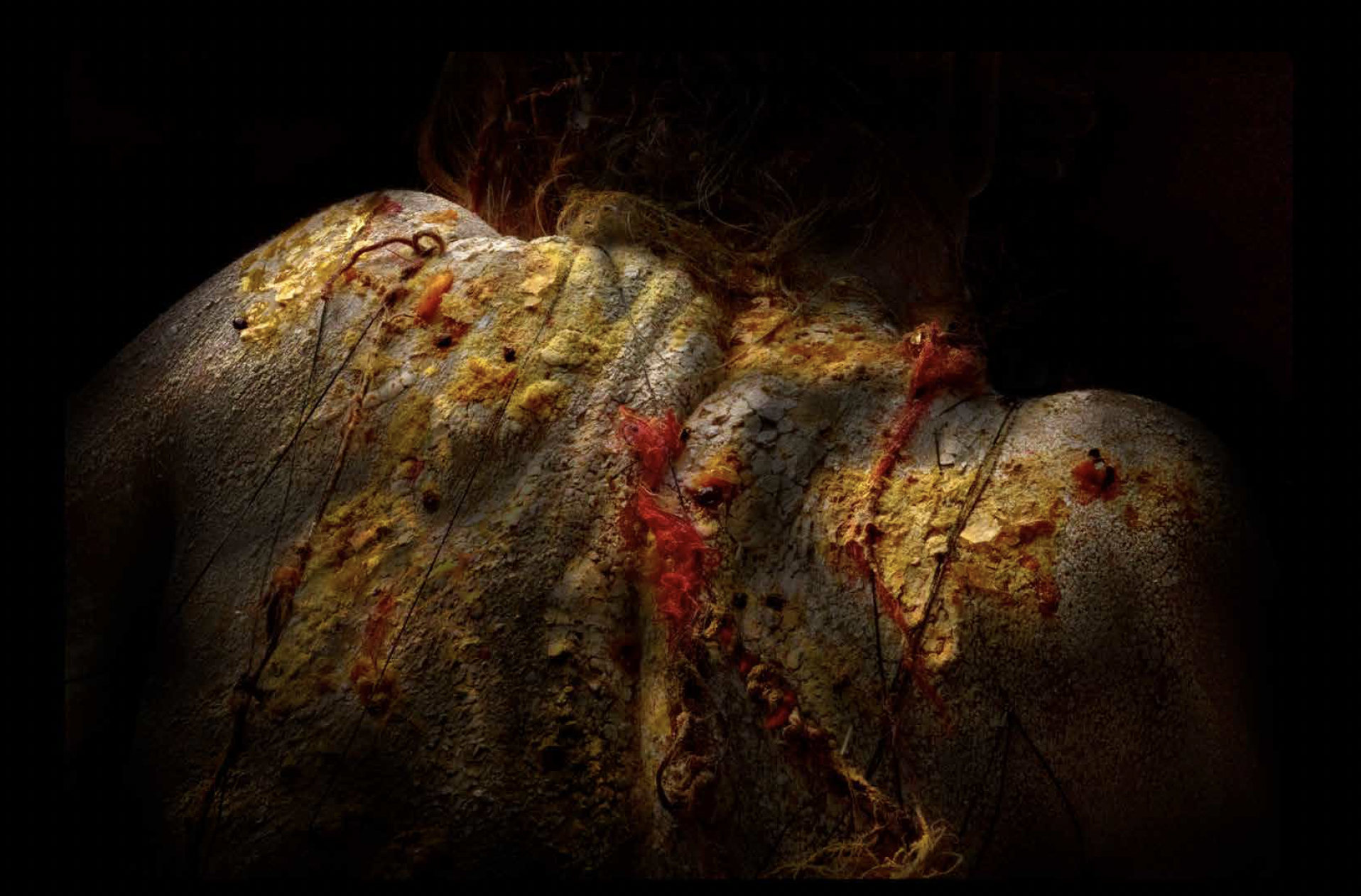
Vincent Ward | Escarpment (The Assyrian came down like the wolf on the fold, And his cohorts were gleaming in purple and gold) 2016 -2026 Pigment print on Hahnemühle fine art paper on Dibond, ed 5 + 2 AP1060 x 715 mm

Vincent Ward | Kaitiaki / Guardian (Kin) (2007-25) pigment print on Hahnemühle fine art paper, edition 1/9 (frame:d) 580 x 945 x 38 mm
kaitiaki
This is an artistic (non documentary) rendition of Niki, a Maori, regarded as a man-child (who in Western thought was considered schizophrenic but in contrast, Maori belief was considered close to the spiritual realm) and his encounter with a kaitiaki a (spiritual guardian). It was told to me when I went looking for Niki many years after he and his mother Puhi had passed away.
This video artwork like the story captures concepts of guardianship, tupuna (ancestry) and kin.
Niki at 43 years old, was a large man weighing in at 240 pounds. When he was near people Niki would duck his head down, shielding his face with one hand and when no one was watching covertly peer out from behind his fingers. His other arm dropped like a pendulum down his side to a half hidden hand shaking spasmodically. His extreme shyness meant that unless he was accompanied by his 84-year old mother, Niki seldom approached people, preferring the safety of his three friends: his mother, the cat and most strikingly a wild white stallion that locals were afraid of and that only Niki could approach.
When his mother died he strayed away from his home in the tiny valley hamlet of Matahi and went further afield, along the claustrophobic tracks, deeper into the Urewera ranges. There he would pitch camp, preferring to live alone in the bush. Or sometimes when closer to town he would dwell in a bivouac that he had built under a bridge. On the rare occasions when he was overcome by the need for company he would walk the many miles to the local pub, slaking his shyness and tiredness with booze. Drunk, he would start a fight. One local, a social worker told of how: “he was beaten up in a pub brawl and left lying naked and bleeding in the middle of the street, where the white horse found him.”
Many of the 80 largely local people who appeared in the film about him and his mother, felt that the horse visiting him on that country street, carried the wairua (spirit) of his dead mother, come to watch over him - a guardian (kaitiaki) from beyond the veil.
Niki died, and they laid his open coffin out near the veranda of the meeting house. A neighbour spoke of the same horse: “one night, breaking through the gate into the (marae) meeting grounds.”
The horse wild eyed, in some sort of state galloped back and forth in front of where Niki was lying. It was widely believed by the mourners that it was inhabited by his mother Puhi coming to take him over to the other side.
Vincent Ward.